Cabinet Door Sample Thickness and Profile
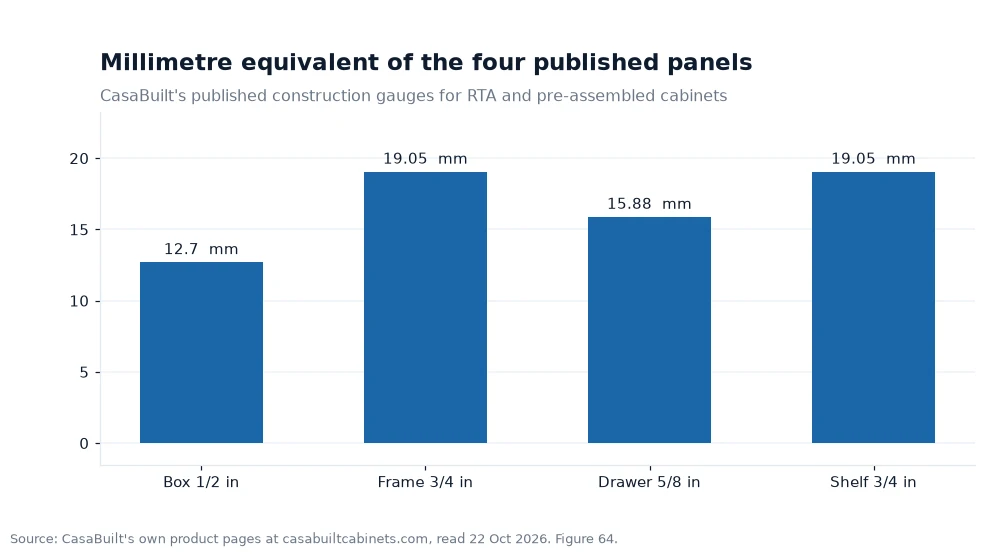
A door sample is a profile, not a caliper reading. The thickness that matters in a CasaBuilt cabinet is published in four places: a 1/2-inch box, a 3/4-inch face frame, a 5/8-inch drawer and a 3/4-inch shelf. In millimetres those are 12.7, 19.05, 15.88 and 19.05. The sample shows you the shape and the overlay; the numbers tell you what sits behind it.
Key takeaways
- The published box is 1/2 inch, or 12.7 mm, in birch plywood.
- The face frame is 3/4 inch by 1-1/2 inch solid birch, or 19.05 mm thick.
- The drawer is 5/8 inch, or 15.88 mm, in rubberwood with dovetail joints.
- The shelf is 3/4 inch plywood, or 19.05 mm, and adjustable.
Four gauges that decide how a cabinet feels
Buyers tend to judge a cabinet by the door, but the door is the thinnest part of the story. The box carries the weight, the face frame stiffens the opening, the drawer takes the daily pull and the shelf carries the plates. Each of those parts has a published gauge, and each gauge does a different job. Change one and the cabinet feels different even when the door looks identical.
The 1/2-inch birch plywood box is the structural shell. It is thick enough to hold a screw at a hinge plate and light enough that a wall cabinet can be lifted by one person. The 3/4-inch by 1-1/2-inch solid birch face frame is the stiffener across the front. It resists the racking force that arrives every time a door is pulled, and it gives the hinges a solid edge to bite into.
The 5/8-inch rubberwood drawer with dovetail joints is the moving part. A drawer side takes more abuse than a shelf because it flexes every time it opens, and 5/8 inch is a common compromise between stiffness and weight. The 3/4-inch plywood shelf is the static part, adjustable in the published spec, with a half-depth shelf in base cabinets.
Inch and millimetre on the same page
Most US cabinet listings are written in inches, and most hardware and appliance specs are written in millimetres. A buyer comparing a cabinet to a European appliance or a metric tape measure needs both. The conversion is exact at 25.4 mm per inch, so the published gauges translate cleanly.
| Panel | Published gauge | Millimetre equivalent | Where it appears |
|---|---|---|---|
| Box | 1/2 in | 12.7 mm | Cabinet sides, bottom and back |
| Frame | 3/4 in | 19.05 mm | Solid birch face frame at the opening |
| Drawer | 5/8 in | 15.88 mm | Rubberwood drawer sides, dovetailed |
| Shelf | 3/4 in | 19.05 mm | Adjustable plywood shelf |
Two rows share the same number for a reason. The face frame and the shelf are both 3/4 inch, but they are different materials doing different work: solid birch in the frame, plywood in the shelf. The drawer sits between the box and the frame at 5/8 inch, and the box is the thinnest of the four at 1/2 inch. That ordering is worth remembering when a competitor quotes a single thickness for the whole cabinet.
Overlay and the gap line
Thickness is only half of the profile story. The other half is overlay, which decides how much of the face frame the door covers. CasaBuilt lists the door as full overlay and Slim Shaker, with a rubberwood frame and an MDF panel. Full overlay means the door sits in front of the frame rather than inside it, so the gap between adjacent doors becomes the visible line across a run.
A 3/4-inch face frame gives the hinge something substantial to attach to, and full overlay hides most of it. The result is a flatter front and a narrower reveal. On a slim profile the frame is narrow, so the door covers almost the entire opening and the shadow line is thin. On a wider Shaker profile the recess is deeper, and the same overlay produces a stronger shadow. Two doors with identical thickness can therefore look completely different on the wall.
Order a cabinets door sample and look at it edge-on before you look at the face. The edge shows the door construction; the face shows the overlay and the reveal. Hold two profiles side by side and the difference in shadow line is obvious, which is the part a dimension table cannot draw for you.
What the sample proves and what it does not
The sample proves the profile, the finish and the edge treatment. It does not prove the box gauge, because the sample has no box. It does not prove the drawer gauge, because the sample has no drawer. It does not prove that the shelf is adjustable or that the face frame is solid birch. Those claims live in the published specification and in the cabinet that arrives, not in the sample box.
That is not a reason to skip the sample. It is a reason to use it for the right question. A sample answers whether the profile suits the room, whether the finish holds up in the light and whether the edge is closed. The specification answers whether the cabinet is built the way you expect. A buyer who checks both is protected on the parts that a photograph cannot show.
If the plan is to avoid assembly, CasaBuilt's pre-assembled cabinet collection uses the same published construction without the flat-pack step. Compare the two lines on the same gauge table rather than on the door alone, because the door is identical while the work behind it is not.
Worked example
The chart gives four published gauges in millimetres: box 12.7 mm, frame 19.05 mm, drawer 15.88 mm and shelf 19.05 mm. Each is the inch value multiplied by 25.4. The box is 0.5 times 25.4, or 12.7 mm. The frame is 0.75 times 25.4, or 19.05 mm. The drawer is 0.625 times 25.4, or 15.875 mm, which is rounded to 15.88 mm in the published figure. The shelf is the same 0.75-inch gauge as the frame, so it is also 19.05 mm.
The frame is 19.05 divided by 12.7, or 1.5 times the box thickness, a difference of 6.35 mm, which is exactly 1/4 inch. The drawer sits 15.88 minus 12.7, or 3.18 mm above the box gauge, and 19.05 minus 15.88, or 3.17 mm below the frame. Those 3 mm steps are small on a tape measure but large in how a cabinet feels: the frame is stiff, the box is light and the drawer is sized for daily movement. The shelf and frame match at 19.05 mm, which is why the shelf can carry a full load of plates without a visible sag over a standard width.
Frequently asked questions
How thick is a cabinet door sample?
The published gauges describe the cabinet, not the door slab: the box is 1/2 inch, the face frame 3/4 inch, the drawer 5/8 inch and the shelf 3/4 inch. The door itself is listed as a rubberwood frame with an MDF panel, and the sample is for judging its profile, finish and overlay.
What does full overlay mean?
The door sits in front of the face frame and covers most of it, rather than fitting inside the opening. On a Slim Shaker profile the narrow frame and full overlay produce a thin shadow line between doors; a wider profile produces a deeper recess.
Why is the shelf the same thickness as the face frame?
Both are published at 3/4 inch, or 19.05 mm, but they are different materials: solid birch for the face frame and plywood for the adjustable shelf. Matching thickness does not mean matching part, and the frame carries hinge loads while the shelf carries storage weight.
Measure the cabinet, judge the door
Use the sample for profile, finish and edge, and use the published gauges for the box, frame, drawer and shelf. Write the four millimetre values on the same sheet as your cabinet list, so a metric appliance spec or a metric tape measure does not become a separate conversation. The door sample costs $9.99 and comes back with the purchase; the gauge table costs nothing and prevents the more expensive mistake.
Figures quoted here come from the manufacturer's own website, read 22 Oct 2026[1].