From Brief to Shelf: Where Perfume Lead Times Really Go
Most perfume projects do not run late because manufacturing is slow. They run late because the decision loop between sample rounds is slow, and because testing and compliance stages are planned as if they happen instantly. A realistic timeline is built from four clocks — development, sampling decisions, compliance work and production — and only one of them belongs to the factory. Knowing which clock is running is the difference between a plan and a hope.
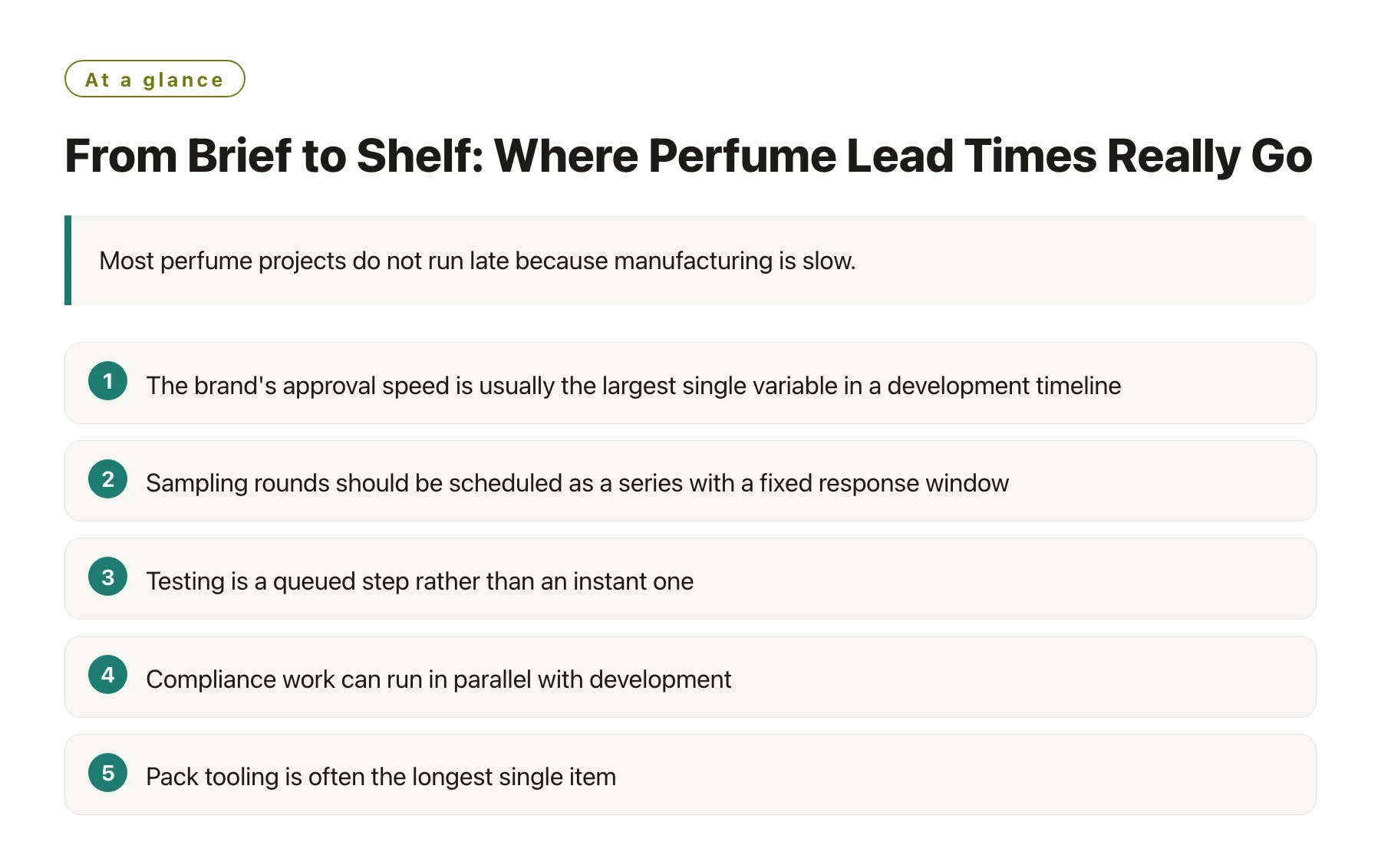
Key takeawaysThe brand's approval speed is usually the largest single variable in a development timeline, and it is also the one the brand fully controls. · Sampling rounds should be scheduled as a series with a fixed response window, not as a single milestone. · Testing is a queued step rather than an instant one, so laboratory turnaround belongs in the plan from the start [1]. · Compliance work can run in parallel with development, which is why late compliance review is a planning error rather than a regulatory delay. · Pack tooling is often the longest single item, and it can be started before the scent is final in many projects.
Ask three suppliers for a timeline and you will get three answers, usually with the same stages in a different order. The differences are not deception; they reflect genuinely different assumptions about how fast the brand will respond and how much of the work can overlap.
The useful way to read any timeline is to split it into stages that can run in parallel and stages that cannot. Development before selection is sequential. Compliance, artwork and pack sourcing are not, and a plan that runs them in a line wastes weeks for no reason.
What follows is the stage map, the driver behind each duration, and the point where each stage commonly slips.
The stage map
| Stage | What drives the duration | Who owns the clock | Where it slips |
|---|---|---|---|
| Brief | How specific the brief is and how many rounds the brand wants to screen | Brand | Brief arrives in pieces and screening restarts |
| Development and trials | Number of directions, complexity of the brief, bench queue | Manufacturer | A direction proves impossible at the target cost |
| Brand decision per round | How many people have to agree, and whether they meet weekly | Brand | The sample sits unread for two weeks |
| Compliance review | Destination markets, ingredient data completeness, external assessment [2] | Shared | Started after selection instead of during it |
| Pack and tooling | Whether the format is stock or new, and the decoration method | Shared | Decided after the scent is approved |
| Testing | Test list, laboratory queue, sample submission quality [1] | Third party | Tests excluded from the quote and commissioned late |
| Production and filling | Order volume, line scheduling, component availability | Manufacturer | Components arrive after the fill slot is booked |
Two rows in this table belong to the brand. In most projects they are also the two that consume the most calendar time, which is why the first useful question about any timeline is not 'how fast can you make it' but 'how fast can you decide'.
The parallel track most brands forget
Compliance, artwork and pack sourcing can all advance while the scent is still being revised, and in a well-run project they do. The formula's ingredient data can be collected and checked, the pack format can be selected and quoted, and the label can be drafted from the intended claims — all before the final sample is chosen.
The only stage that genuinely cannot start early is printing, because the artwork depends on the approved formula and the pack. Everything upstream of printing can overlap, and pulling even one of those stages forward often removes two or three weeks from a launch date.
It is worth seeing how a manufacturer sequences these stages before you build a plan. Learn more about a typical production scope and check whether its stages map onto your timeline; if the supplier describes a sequence that only runs in a line, ask which parts could run in parallel instead.
Testing has a queue, not a duration
Laboratory turnaround is not a fixed number of days; it is a submission and a queue. Third-party testing providers publish what each test covers and how samples should be submitted, and a submission that arrives incomplete restarts the clock [1].
The practical rule is to confirm the test list, the sample quantity, the labelling of the samples and the destination laboratory before the production run is scheduled. Ten minutes of preparation at that point is worth a week later.
Compliance assessment is external time
Where a market requires a scientific assessment of an ingredient, that assessment runs on its own schedule and is partly outside the manufacturer's control [2]. Build that possibility into the plan for any product using unusual materials, and treat a formula that avoids a pending question as a schedule advantage rather than a compromise.
How to compress a timeline without buying risk
Two levers are safe and two are not. The safe ones are parallel work and decision discipline: run compliance and pack sourcing alongside development, and fix a response window for each sample round with a named decision-maker. The unsafe ones are skipping a sample round and commissioning production before the reference sample is signed.
There is a third safe lever that buyers underuse: start the pack before the scent is final. If the bottle format is stock and the decoration is stable, tooling and component lead times can run in parallel with the development track, and the only thing waiting on the formula is the print.
If the project involves an existing formula with a defined direction, production capacity and lead times is a useful next read, because the constraints shift from development to scheduling. For a project starting from nothing, the sequence in the steps behind a new fragrance brand maps more closely to what the first four months look like.
One more thing worth checking early: whether development and filling sit under one schedule. A partner such as a factory that handles fragrance R&D and production removes a handover between two sites, and that handover otherwise costs both time and a failure point.
A timeline is a promise about decisions as much as about machines. If the brand's approval window is not written into the plan, the plan is describing a factory and not a project.
Build the schedule backwards from the shelf date and mark every stage that depends on a human decision. Those stages are the ones to shorten first, and they are almost always cheaper to fix than the production stages.
Sources
- SGS: Cosmetics, Personal Care & Household Testing —— Testing, inspection and certification services for cosmetics and personal care, including microbiological, stability and safety testing aligned with cosmetics GMP.
- EU Scientific Committee on Consumer Safety (SCCS) —— The EU scientific committee that issues opinions on the safety of cosmetic ingredients, including fragrance allergens and their labelling thresholds.
Frequently asked questions
How long does it take to develop a custom fragrance?
It depends mainly on how many directions are screened and how fast the brand responds, rather than on the bench work itself. Ask for a stage plan with a response window written in, and treat the response window as part of the schedule.
Can packaging tooling start before the scent is approved?
In many projects yes, particularly when the bottle is a stock format and only the decoration is bespoke. Tooling and component lead times can then run alongside development, and only the printing waits on the final formula.
What is the most common cause of a missed launch date?
A sample sitting unread while the team waits for a meeting. Development, testing and production all have predictable durations; internal approval does not, and it is the one delay that no supplier can recover for you.
Should testing be scheduled before or after production?
Confirm the test list and sample requirements before production, then submit from the production run. Scheduling tests early lets you reserve laboratory time and catch a submission-format problem while there is still room in the schedule.
How much buffer should a first launch build in?
Enough to cover one extra sample round and one schedule slip in the pack. First projects rarely go exactly to plan, and a buffer that is spent on a real problem is cheaper than a buffer that was never there.